Category Archives: Tools

Guitarmaking Q&A for October 2018

Today’s topics include:
bending florentine cutaways, sourcing guitar plans, creating headstock inlays, deciding the dimensions of a mortise and tenon, installing fretboard inlays on a finished guitar, radiusing fretwire, and radiusing the soundbox.

Want more of this? Subscribe below for Weekly Guitar Making Tips from DIY Guitarmaking


Want to really learn more!? Take a class with Eric Schaefer and build your own guitar in 8 days!

ES BACKGROUND
Or Join The Online Guitar Building School
ES Guitars ONLINE

Guitarmaking Q&A for August 3rd, 2018

Today’s topics include:
carbon fiber inserts and truss rods, intonation and compensation, hiding fractures and splits in the plates, building your own thickness sander and more…

Want more of this? Subscribe below for Weekly Guitar Making Tips from DIY Guitarmaking


Want to really learn more!? Take a class with Eric Schaefer and build your own guitar in 8 days!

ES BACKGROUND
Or Join The Online Guitar Building School
ES Guitars ONLINE

14 Mistakes to avoid when building your first acoustic guitar

I talk about some of the mistakes that beginner luthiers make on their first acoustic guitar.

#1 using woods of opportunity or reclaimed wood
#2 using expensive wood
#3 using highly figured wood
#4 biting off more than you can chew
#5 buying tools in bulk
#6 skipping the dry run
#7 using dull edge tools
#8 using routers inappropriately
#9 using edge tools to carve the neck
#10 thicknessing parts to final dimensions
#11 getting started without the end in mind
#12 sides not square to plates
#13 sanding out of sequence
#14 perfectionism procrastination

Want more of this? Subscribe below for Weekly Guitar Making Tips from DIY Guitarmaking


Want to really learn more!? Take a class with Eric Schaefer and build your own guitar in 8 days!

ES BACKGROUND
Or Join The Online Guitar Building School
ES Guitars ONLINE

Why I like Evo Gold Fretwire

What’s the difference between EVO Gold, Nickel Silver, and stainless steel frets? I talk about the aesthetic appeal, the hardness, the longevity, and the tone of Evo Gold fretwire versus the others.

Want more of this? Subscribe below for Weekly Guitar Making Tips from DIY Guitarmaking


Want to really learn more!? Take a class with Eric Schaefer and build your own guitar in 8 days!

ES BACKGROUND
Or Join The Online Guitar Building School
ES Guitars ONLINE


Template Duplicating Solutions Part 4 – Curves and Corners

This series looks a improving your results when duplicating patterns in the shop. This is especially important for luthiers as we use templates for headstock, bridge, guitar body, and fretboard tongue shapes.

Want more of this? Subscribe below for Weekly Guitar Making Tips from DIY Guitarmaking


Want to really learn more!? Take a class with Eric Schaefer and build your own guitar in 8 days!

ES BACKGROUND
Or Join The Online Guitar Building School
ES Guitars ONLINE


Template Duplicating Solutions Part 2 – Router Bit Options

This series looks a improving your results when duplicating patterns in the shop. This is especially important for luthiers as we use templates for headstock, bridge, guitar body, and fretboard tongue shapes.

Want more of this? Subscribe below for Weekly Guitar Making Tips from DIY Guitarmaking


Want to really learn more!? Take a class with Eric Schaefer and build your own guitar in 8 days!

ES BACKGROUND
Or Join The Online Guitar Building School
ES Guitars ONLINE


Template Duplicating Solutions Part 1 – Cleaning Bits

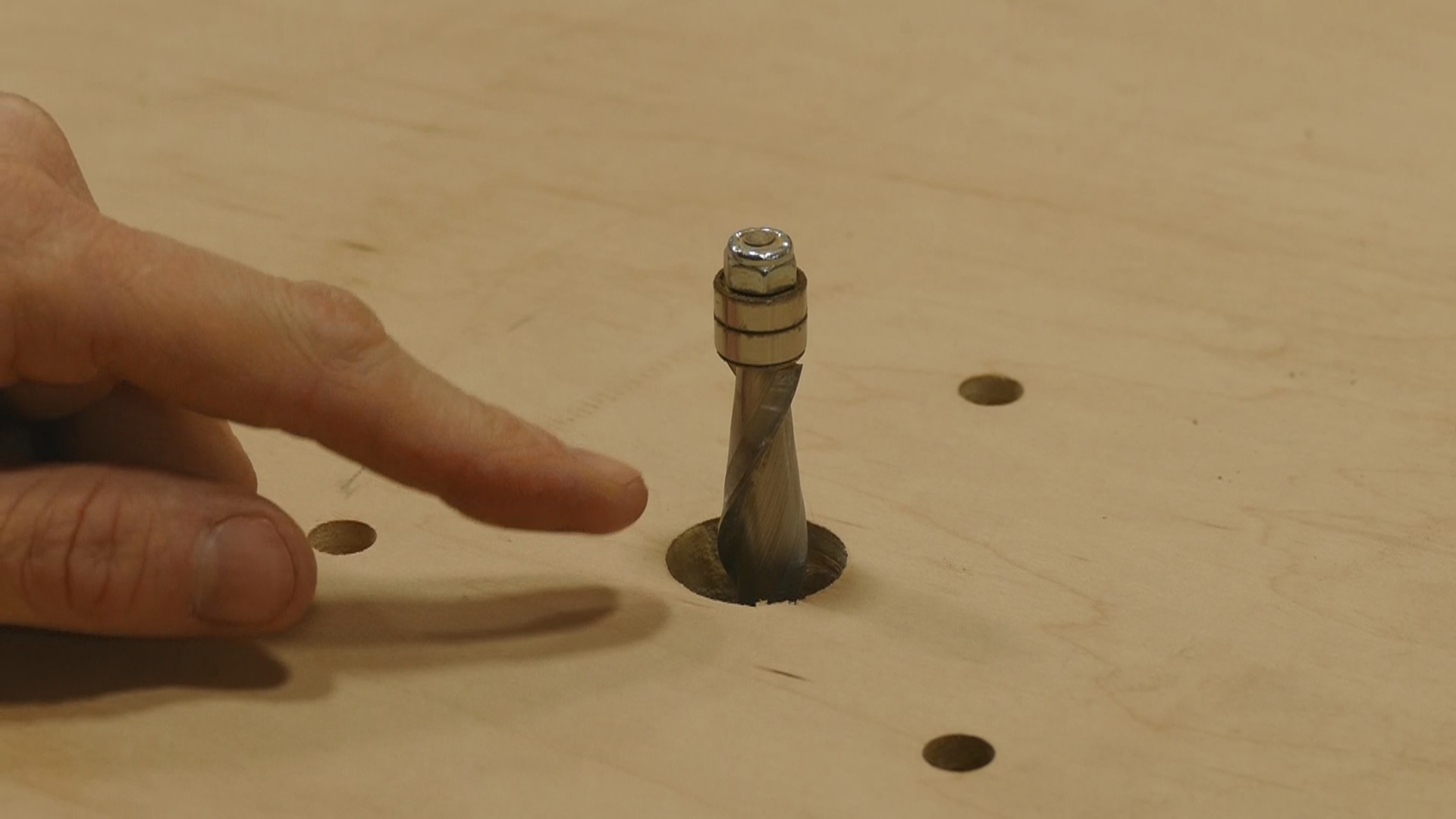
Routers can be a serious source of frustration for woodworkers. I designed this series of videos to explain the solutions to common router problems that I’ve identified.

I’ve specified pattern bits because pattern, or template, routing is a very common usage of routers in the guitar maker’s shop. We use pattern bits to route such things as bridges, headstock patterns, fretboard tongue shapes etc…

This series will be broken up into several parts. This first episode deals with dirty and dull bits. I talk about how to clean them.

Want more of this? Subscribe below for Weekly Guitar Making Tips from DIY Guitarmaking


Want to really learn more!? Take a class with Eric Schaefer and build your own guitar in 8 days!

ES BACKGROUND
Or Join The Online Guitar Building School
ES Guitars ONLINE


The One Tool that I Carry Everywhere

This episode features the one tool that I keep on my person at all times in the shop: The Gerber EAB Lite utility knife. I also give tips for maintaining flat surfaces by trimming the ends on your sanding blocks and my ideas on keeping the right tools within reach.

Want more of this? Subscribe below for Weekly Guitar Making Tips from DIY Guitarmaking


Want to really learn more!? Take a class with Eric Schaefer and build your own guitar in 8 days!

ES BACKGROUND
Or Join The Online Guitar Building School
ES Guitars ONLINE


Variable Pitch Bandsaw Blades: A No-Brainer for Resaw Work

This past summer I spent some time and money improving my setup for resaw work, specifically for resawing tops and back and side sets. I want to share a simple alteration that had a pretty significant impact on the quality of my cuts: That is; purchasing a variable pitch bandsaw blade as opposed to a regular constant pitch blade.

As far as my own experience and research on the matter indicates, there is no reason to even consider a constant pitch blade when a variable pitch blade of the same size and quality exists. In fact, the availability of these blades is the only downside. They are a little harder to find.

So what is a variable pitch blade?

The most important consideration when buying a bandsaw blade, aside from size, is the TPI. TPI stands for Teeth Per Inch. The lower the TPI the better the blade is at evacuating wood debris because the debris is carried out via the large gullets between the teeth. This means that with less TPI you can resaw wider material. This is, of course, necessary for resawing the top and back plates. The drawback of a blade with less TPI is that it leaves a coarser cut.

A blade with more TPI will have a cleaner cut but, with smaller gullets, it doesn’t effectively remove large amounts of wood debris as it cuts. So it cannot handle wider boards.

Enter the variable pitch blade. A variable pitch blade alternates it’s TPI. So on a single blade you have a section of less TPI with large gullets for clearing out wood debris followed by a section of greater TPI for cleaning up the cut.

My new 3/4″ variable pitch blade handles wide boards just as well, if not better, than my old 3/4″ constant pitch blade; with the same speed of cut and without bogging down.

But now the results are far cleaner than they were with my old blade, which means that I save a lot of time planing or sanding things smooth, and I save material too because I know I can afford to make cuts closer to my intended dimensions.

There’s something else that I wasn’t expecting from this blade. The cut is SO quiet! It’s like a kitten purring. Originally, I thought this was just because I shelled out a little more money for a premium blade, and the higher quality metal of the blade somehow made it run with less noise.

But rather, I found through a little research online, that constant pitch blades can develop a flutter due to harmonic vibrations, whereas a variable pitch blade breaks up the pattern of the blade and to a large degree mitigates the problem.

My source for this is Lori Balkus’s blog here. Check it out:

Variable Pitch Bandsaw Blades

Lastly, I want you all to know that the variable pitch blade cost me just as much as the constant pitch blade of the same quality and size. This is why I call it a “No-brainer.” I’ve been using the new blade for about 6 months now and I’m completely sold on the concept.

I’m surprised I don’t see more people in the hobbyist woodworker and guitarmaker space using these blades. I assume this is because many are still using economy blades from department stores. Variable pitch blades are not available from those suppliers, atleast not yet. There are many reasons to upgrade from the economy blades to a premium. This is just another reason to do it.

Anyway, here is the takeaway:

If you intend on upping your game and getting a premium blade for your resaw work, get a variable pitch blade! It’s a no-brainer!


Want more of this? Subscribe below for Weekly Guitar Making Tips from DIY Guitarmaking


Want to really learn more!? Take a class with Eric Schaefer and build your own guitar in 8 days!
ES BACKGROUND
Or Join The Online Guitar Building School

ES Guitars ONLINE


“Knives” for Removal of Fretboards and Bridges

Well, in this case they are not really “knives.” My favorites are all kitchen spatulas modified for removing glue joints. In this episode of DIY Guitarmaking, I discuss my favorite implements for bridge and fretboard removal and for removing double stick tape on templates.

Questions on this topic or anything else related to acoustic instrument construction?

Please e-mail eric@ericschaeferguitars.com with the subject line: DIY Question

And I may answer your question on a Q and A episode of DIY Guitarmaking!

Want more of this? Subscribe below for Weekly Guitar Making Tips from DIY Guitarmaking


Want to really learn more!? Take a class with Eric Schaefer and build your own guitar in 8 days!

ES BACKGROUND
Or Join The Online Guitar Building School
ES Guitars ONLINE